
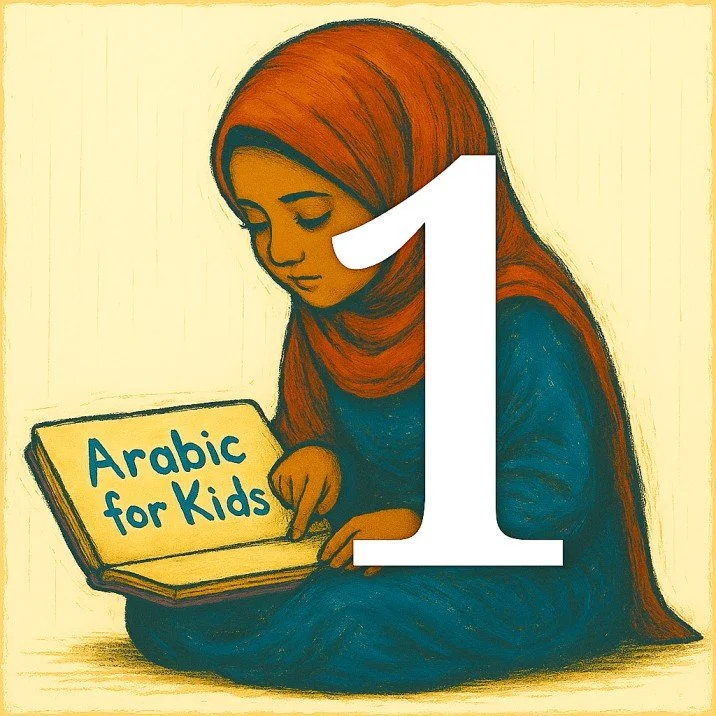
Arabic for Kids
A gentle, story-led pathway into Classical Arabic for children. Through engaging stories and guided practice, students strengthen reading, writing, and comprehension in a way that feels natural and enjoyable. Instead of translating everything back into another language, they learn to understand Arabic directly. Over time, stronger vocabulary, clearer grammar, and smoother reading prepare them to approach the Qur’an and other classical texts with growing confidence.
Our Arabic curriculum follows the Jannaty Series, a program specially designed for children growing up in the West who are learning Arabic as a second language. This series meets the unique needs of these children, connecting them with Arabic in a natural and engaging way. Drawing from years of teaching experience in Western schools, the curriculum balances all language skills (reading, writing, comprehension, and grammar) with cultural and Islamic values. It uses age-appropriate stories, activities, and examples that children can relate to in daily life, making Arabic both practical and meaningful.

The Jannaty Series develops students’ abilities in three progressive stages:
Foundations (ages 6–8): Learning the Arabic alphabet, vowel markings, and forming simple words.
Reading & Comprehension (ages 9–11): Building reading fluency, understanding sentences, and answering questions in Arabic.
Fluency & Grammar (ages 11–13): Mastering short stories, applying grammar rules, and writing structured paragraphs.
What makes our curriculum unique?
Concepts are explained clearly, with links to English when needed so children don’t feel lost or confused by new ideas.
Stories are chosen to build moral values such as honesty, kindness, and respect.
Activities and worksheets are interactive, encouraging children to think in Arabic rather than relying on direct translation.
Parents receive guidance and tips to support practice at home, so learning continues beyond the classroom.
Program Goals
Build strong reading and writing skills step by step.
Develop comprehension directly in Arabic, without over-reliance on translating to English.
Introduce grammar gradually in a practical, child-friendly way.
Support Islamic values through age-appropriate Arabic stories (e.g. honesty, trust, helping others, respecting parents).
Encourage independent learning in a stress-free, enjoyable environment.
Link new Arabic terms to English at the beginning, so children aren’t overwhelmed by difficult concepts – making vocabulary and grammar easier to grasp.
Learning Milestones
-
![]()
Jannaty 101: Your child’s first real step into Arabic
Level 1 builds early literacy: letter recognition and sounds, short vowels (fatha, damma, kasra), and first words and phrases. Children practice joining letters, reading short sentences, and responding to simple instructions in Arabic—beginning to think in Arabic rather than translate every step.
What your child will build:
• Identify, pronounce, and write all 28 letters (isolated forms) • Read 2–3 letter words with short vowels; begin sentence reading • Understand 50–70 everyday words (family, colors, school items, animals, numbers) • Follow simple Arabic classroom instructions (e.g., ijlis, uktub, iftah al-kitab) • Start “reading with the eyes” (less sounding-out, more fluent recognition) • Gentle grammar awareness: recognizing nouns/verbs in context
What’s included
• Short recorded lessons your child can replay anytime
• A weekly 30-minute 1-to-1 session (live) to practice, correct, and build confidence
• PDF textbook included: Jannaty Series — Book 1
• No prior Arabic neededFees: USD$99/month or $249 per 12-week term
Parent partnership:
Short, doable practice (10–15 min/day) using worksheets and quick oral review. We share weekly goals and tips so you always know how to help.
-
![]()
Jannaty 201: Building confident intermediate Arabic
Level 2 develops fluency and comprehension. Students read smoothly with sukoon, tanween, and shaddah, expand topic-based vocabulary, and practice short dialogues and guided writing. They answer comprehension questions in Arabic, relying less on translation.
What your child will build:
• Fluent reading of words/sentences with sukoon, tanween, shaddah • 100+ new words across daily themes (food, clothing, home, routines) • Short dialogues & role-plays (greetings, routines, requests) • Write structured sentences (S-V-O) and starter paragraphs (3–4 sentences) • Comprehension directly in Arabic (listen/read → answer in Arabic) • Solidify core patterns (nominal & verbal sentences)
What’s included
• Short recorded lessons your child can replay anytime
• A weekly 30-minute 1-to-1 session (live) to practice, correct, and build confidence
• PDF textbook included: Jannaty Series — Book 2
• Prerequisite: completion of Level 1 (or equivalent foundation)Fees: USD $99/month or $249 per 12-week term
Parent partnership:
Weekly update with progress points + a mini practice plan (5–10 min/day). Short answer keys provided for quick checks.
-
![]()
Jannaty 301: Expressing ideas with understanding and clarity
Level 3 brings confident, expressive reading of age-appropriate stories, meaning-first comprehension without translation, and applied grammar (nominal vs. verbal sentences, agreement, common particles). Students write short, coherent paragraphs and refine pronunciation and rhythm in oral reading.
What your child will build:
• Smooth reading of longer passages with expression and pacing • Retell stories in Arabic using familiar structures and new vocabulary • Apply core grammar: sentence types, agreement (m/f, sg/pl), common particles • Write 4–6 sentence paragraphs; improve spelling via dictation • Extract moral lessons (adab/values) from texts and discuss them in Arabic
Choose your pathway from the start of Level 3:
• Classical Arabic only: Continue the full Arabic track
• Hifz & Tajweed only: Shift focus to Qur’an memorization/recitation
• Blended Track: One Arabic + one Hifz/Tajweed session per weekWhat’s included
• Short recorded lessons your child can replay anytime
• A weekly 30-minute 1-to-1 session (live) to practice, correct, and build confidence
• PDF textbook included: Jannaty Series — Book 3
• Prerequisite: completion of Level 2 (or equivalent)Fees: USD $99/month or $249 per 12-week term


“What I appreciate most is the teacher's patience, encouragement, and personalized approach. The supportive environment has made my child feel comfortable and motivated to strive for their best. The teaching style is practical, compassionate, and highly effective, which has fostered both learning and a deep connection to the material.”
— Hala, United Kingdom
The Sufuuf Learning Journey
Rather than choosing between structure and personalization, we bring both together. Our children work through a carefully sequenced curriculum of recorded lessons and assessments, supported by regular private sessions that adapt learning to the child—not the other way around.
-
Each course follows a 12-week sequence designed to feel steady and manageable. Students learn new material through a recorded lesson, then reinforce it through guided practice, and finally apply it in a live session where the teacher corrects, refines, and builds real fluency.
-
Most families follow a simple weekly rhythm. Early in the week, your child watches one recorded lesson (typically around 20–30 minutes) that introduces new concepts and models correct reading and pronunciation. Midweek is kept light, with short worksheets or drills that take about 10–15 minutes. Toward the end of the week, your child meets the teacher for a live 30-minute 1-to-1 session on Zoom to practice actively, receive feedback, and strengthen accuracy.
-
All learning resources are included: the required PDF textbook(s), lesson slides, audio practice loops, and printable worksheets. Recordings and printables are organized in a parent portal (a simple download area on the website), so you can revisit lessons and keep practice consistent without chasing files.
-
Every student receives a private 30-minute one-to-one class each week. For Arabic, we can also arrange small-group sessions (usually 2–3 learners) when it supports motivation and progress. Qur’an recitation, Tajwīd, and ḥifẓ remain primarily one-to-one, since precision and correction are central to that track.
-
You’ll receive brief weekly notes that highlight progress and give practical guidance—especially what to listen for during reading and pronunciation practice. At the end of the course, we share a clear report outlining strengths, current focus areas, and the most suitable next step in the pathway.
-
Certification
Why Families Choose Sufuuf al-Khayr?
-
We fit around your home, not the other way around. With 1-on-1 lessons offered across time zones and multiple time-slot options, it’s simple to find a rhythm you can keep—week after week.
-
From early readers (6–8) to pre-teens (11–13), goals and teaching styles are age-appropriate and child-friendly. We meet learners where they are, then build up, one step at a time.
-
Your child has the teacher’s full focus. That means immediate correction, calm encouragement, and faster, more confident progress than crowded classes can offer.
-
We cultivate adab, focus, and joy. Lessons are gentle, organized, and uplifting, helping children love what they learn, and who they’re becoming.
“Since joining the program, my child has shown incredible growth, not only in their Qur’anic recitation and understanding of Arabic but also in their overall discipline and enthusiasm for learning. Their progress has been remarkable, and they are now much more confident in their abilities.”
— Yasmin, United States
Frequently Asked Questions
-
Most students begin between 6–8 years of age for Level 1. Older beginners are always welcome; we adapt pacing.
-
Plan on 10–15 minutes/day (very manageable). We provide clear, parent-friendly tasks.
-
All three. Speaking is integrated through short dialogues, retells, and role-play.
-
Ongoing checks in the live session + end-of-course review. Parents receive a concise progress summary with next-step goals.
-
Yes! Textbook PDFs, slides, and worksheets are provided for each course.
-
Yes. Levels 1–2 prepare children for Qur’an reading and Hifz. Many families add or switch in Level 3.