
ArabiTalk
ArabiTalk is a structured online Arabic conversation program designed especially for Muslim children ages 7–13 learning Arabic in a warm, Islamic, child-friendly environment.
Through guided dialogues, everyday vocabulary, pronunciation practice, and child-friendly themes like greetings, family, food, routines, and about themselves, children begin connecting with Arabic as a living language.

Rather than relying on memorizing long vocabulary lists or translating every word into English, students learn Arabic through context, repetition, guided interaction, and meaningful practice.

The program is especially suitable for Muslim children who are beginning to connect with Arabic as the language of the Qur’an, Islamic learning, daily expressions, and communication. While this is not a Qur’an memorisation course, it gives students the Arabic reading and comprehension foundation that supports their wider Islamic education.

Teaching Approach
ArabiTalk uses the child’s English understanding as a bridge into Arabic, but the lessons are not built around direct translation.
Instead, children learn meaning naturally through:
• guided speaking practice
• teacher modelling and repetition
• short Arabic dialogues
• question-and-answer practice
• visual prompts and real-life themes
• sentence building
• listening and response activities
• interactive exercises and role-play
This helps students connect Arabic words to real situations, so they can begin thinking, responding, and communicating more naturally in Arabic.
Program Goals
Build confidence speaking simple Arabic
Understand and use everyday Arabic vocabulary
Practise common phrases used in daily conversation
Improve pronunciation and listening comprehension
Ask and answer simple questions in Arabic
Use new words in short guided sentences
Grow less dependent on English translation
Develop a stronger foundation for future Arabic and Islamic studies
Learning Milestones
-
![]()
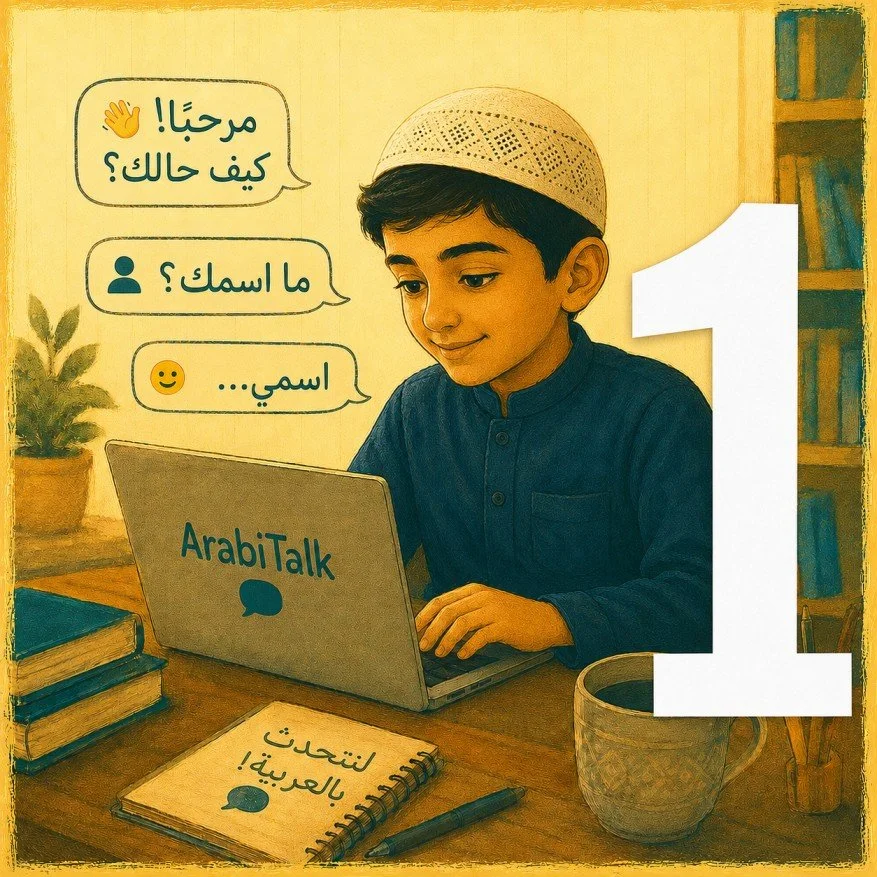
ArabiTalk 101: Your child’s first real step into Spoken Arabic
ArabiTalk 101 introduces children to simple Arabic conversation in a gentle, structured, and encouraging way. Students begin with everyday words and phrases they can actually use — greetings, names, family, likes, routines, common objects, and simple questions.
The focus is on helping children feel comfortable hearing Arabic, repeating Arabic, and using Arabic in short guided exchanges. Reading and pronunciation support are included where needed, but the main goal is to build early confidence in communication.
What your child will build:
• Confidence using basic Arabic greetings and introductions
• Ability to say simple phrases such as “My name is…”, “How are you?”, and “I am fine”
• Topic-based vocabulary related to self, family, home, food, and daily life
• 5–8 new useful Arabic words introduced per session
• Short guided sentences using familiar vocabulary
• Listening practice through teacher-led Arabic prompts
• Speaking practice through repetition, role-play, and simple responses
• Improved pronunciation of Arabic words and phrases
• Early comprehension without relying only on English translation
• A warm foundation for future Arabic, Qur’an, and Islamic learningWhat’s included
• Live online one-to-one Arabic sessions
• Guided conversation practice
• Short dialogues and role-play activities
• Pronunciation support and correction
• Vocabulary practice through real-life themes
• Listening and response exercises
• Simple sentence-building activities
• Recorded lesson each week with homework instructions, revision guidance, and practice tasks for the child to complete before the next class
• Parent updates on progress and recommended home practicePrerequisite
ArabiTalk 101 is suitable for children who are beginning their spoken Arabic journey.
Some familiarity with Arabic sounds or letters is helpful, but the course is not taught as an alphabet or grammar course. Students with very limited Arabic can begin here, and placement support is available where needed.
Outcome
By the end of ArabiTalk 101, students should be able to understand and use simple Arabic words, greetings, introductions, and short guided sentences with growing confidence.
They should be able to participate in basic teacher-led exchanges and recognise everyday vocabulary connected to familiar topics.
Fees
USD $99/month per child
-
![]()
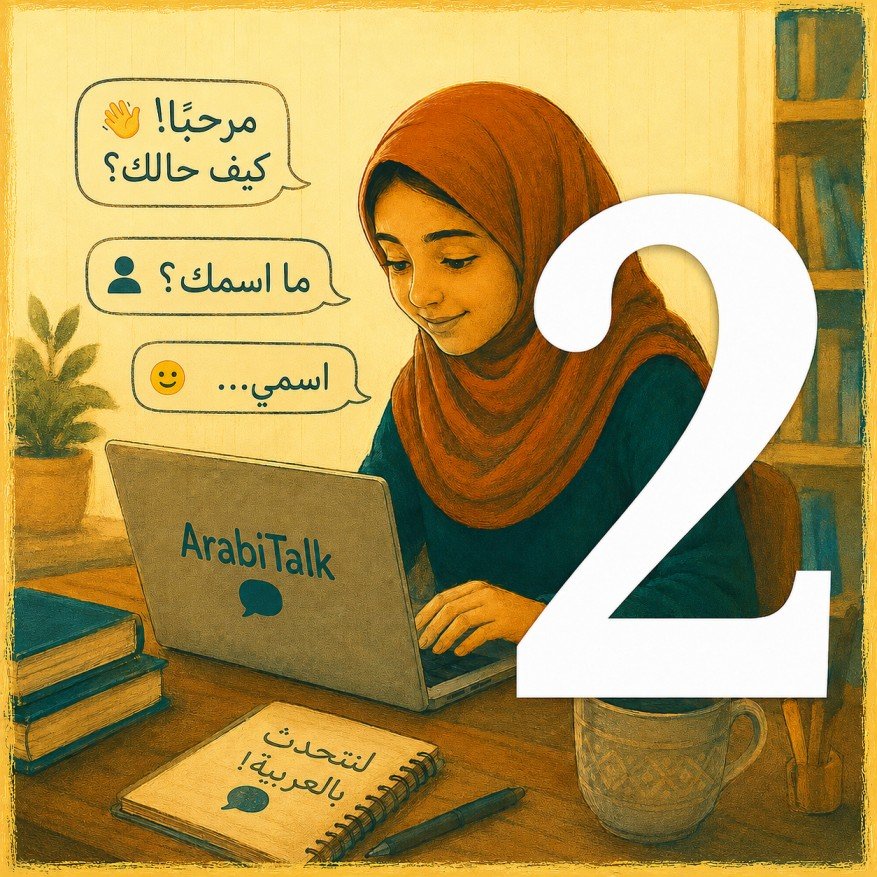
ArabiTalk 201: Building confident Spoken Arabic
ArabiTalk 201 helps students move from short phrases into fuller Arabic conversation. Students build on their foundation by learning more vocabulary, answering simple questions, forming short sentences, and practising guided dialogues around everyday topics.
This level develops confidence, fluency, comprehension, and active use of Arabic. Students begin to rely less on English and become more comfortable understanding Arabic in context.
A key unit in this level is “About Me,” where students learn to speak and understand Arabic related to themselves, their family, routines, interests, and surroundings.
What your child will build:
• Greater confidence speaking in short Arabic exchanges
• Comprehension of at least 90 Arabic words by the end of the “About Me” unit
• Topic-based vocabulary related to self, family, home, routines, food, and daily life
• Ability to answer simple questions in Arabic
• Ability to use new vocabulary in guided spoken sentences
• Short dialogues and role-plays based on real-life situations
• Listening comprehension through Arabic prompts and responses
• Improved pronunciation, rhythm, and fluency
• Less dependence on direct English translation
• Stronger preparation for future Arabic and Islamic studiesWhat’s included
• Live online one-to-one Arabic sessions
• Guided speaking and conversation practice
• Short dialogues and role-play activities
• Introduction of 5–8 new vocabulary words per session
• Sentence-building exercises using new vocabulary
• Listening and comprehension practice
• Pronunciation correction and fluency support
• In-class revision and guided practice
• Recorded lesson each week with homework instructions, revision guidance, and practice tasks for the child to complete before the next class
• Continuous progress checks
• Parent updates with recommended home practicePrerequisite
Completion of ArabiTalk 101 or equivalent basic Arabic exposure.
Students should be able to understand and use some simple Arabic words or phrases. Placement is based on ability rather than age or school grade.
Outcome
By the end of ArabiTalk 201, students should be able to understand and use key vocabulary from the “About Me” unit, answer simple questions in Arabic, and participate in short guided conversations with improved confidence.
They should also be able to recognise and comprehend at least 90 Arabic words connected to familiar daily themes.
Fees
USD $99/month per child
“What I appreciate most is the teacher's patience, encouragement, and personalized approach. The supportive environment has made my child feel comfortable and motivated to strive for their best. The teaching style is practical, compassionate, and highly effective, which has fostered both learning and a deep connection to the material.”
— Hala, United Kingdom
The Sufuuf Learning Journey
Rather than choosing between structure and personalization, we bring both together. Our children work through a carefully sequenced curriculum of recorded lessons and assessments, supported by regular private sessions that adapt learning to the child—not the other way around.
-
Each course follows a 12-week sequence designed to feel steady and manageable. Students learn new material through a recorded lesson, then reinforce it through guided practice, and finally apply it in a live session where the teacher corrects, refines, and builds real fluency.
-
Most families follow a simple weekly rhythm. Early in the week, your child watches one recorded lesson (typically around 20–30 minutes) that introduces new concepts and models correct reading and pronunciation. Midweek is kept light, with short worksheets or drills that take about 10–15 minutes. Toward the end of the week, your child meets the teacher for a live 30-minute 1-to-1 session on Zoom to practice actively, receive feedback, and strengthen accuracy.
-
All learning resources are included: the required PDF textbook(s), lesson slides, audio practice loops, and printable worksheets. Recordings and printables are organized in a parent portal (a simple download area on the website), so you can revisit lessons and keep practice consistent without chasing files.
-
Every student receives a private 30-minute one-to-one class each week. For Arabic, we can also arrange small-group sessions (usually 2–3 learners) when it supports motivation and progress. Qur’an recitation, Tajwīd, and ḥifẓ remain primarily one-to-one, since precision and correction are central to that track.
-
You’ll receive brief weekly notes that highlight progress and give practical guidance—especially what to listen for during reading and pronunciation practice. At the end of the course, we share a clear report outlining strengths, current focus areas, and the most suitable next step in the pathway.
-
Certification
Why Families Choose Sufuuf al-Khayr?
-
We fit around your home, not the other way around. With 1-on-1 lessons offered across time zones and multiple time-slot options, it’s simple to find a rhythm you can keep—week after week.
-
From early readers (6–8) to pre-teens (11–13), goals and teaching styles are age-appropriate and child-friendly. We meet learners where they are, then build up, one step at a time.
-
Your child has the teacher’s full focus. That means immediate correction, calm encouragement, and faster, more confident progress than crowded classes can offer.
-
We cultivate adab, focus, and joy. Lessons are gentle, organized, and uplifting, helping children love what they learn, and who they’re becoming.
“Since joining the program, my child has shown incredible growth, not only in their Qur’anic recitation and understanding of Arabic but also in their overall discipline and enthusiasm for learning. Their progress has been remarkable, and they are now much more confident in their abilities.”
— Yasmin, United States
Frequently Asked Questions
-
Most students begin between 6–8 years of age for Level 1. Older beginners are always welcome; we adapt pacing.
-
Plan on 10–15 minutes/day (very manageable). We provide clear, parent-friendly tasks.
-
All three. Speaking is integrated through short dialogues, retells, and role-play.
-
Ongoing checks in the live session + end-of-course review. Parents receive a concise progress summary with next-step goals.
-
Yes! Textbook PDFs, slides, and worksheets are provided for each course.
-
Yes. Levels 1–2 prepare children for Qur’an reading and Hifz. Many families add or switch in Level 3.