

It is time for your child’s Qur’an lesson. You call them over, but they are busy playing. You remind them again, and they say they are tired. A few minutes later, what was meant to be a peaceful moment with the Book of Allah has turned into a negotiation, and perhaps an argument.
Almost every parent who loves the Qur’an reaches this moment. You want your child to recite well and grow up with the words of Allah close to their heart, and you worry that insisting too hard might make them dislike the very thing you hoped they would love. So the question arrives, along with three uncomfortable options. Push harder, let it go, or negotiate every evening until everyone is worn out.
Each of those can go wrong. Pushing without wisdom can leave a child resenting the very thing you hoped they would love. Letting it go can leave them with a Qur’an they never really got to know. Endless bargaining teaches that effort is optional if you protest loudly enough.
This post offers a fourth way. Parents should be firm about the importance of the Qur’an and gentle in the path they build towards it. We will look at what the Prophet ﷺ taught about dealing with children, the signs that pressure has tipped into harm, and practical steps that keep the routine alive without turning it into a battle.
The short answer. Do not abandon the Qur’an because your child resists, and do not use force that frightens, shames or hurts them. Keep a short, consistent and loving routine, and adjust the pace together with your child’s teacher.
Qur’an learning needs both love and discipline
Children need routine, and a daily Qur’an routine is one of the best they can have. A child who recites at roughly the same time most days, even briefly, builds a habit that outlasts any single mood. Parents who drop the Qur’an whenever the child resists can find that the resistance grows, because the child learns that complaining works.
Consistency is a Prophetic value as well. The Prophet ﷺ taught that the deeds most beloved to Allah are the most regular ones, even when they are small (al-Bukhārī 6464; Muslim 783). Ten calm minutes most days will usually take a child further than an hour of struggle once a week.
Force without wisdom is a different matter. What a child feels while learning stays with them longer than what they memorise. A lesson driven by anger, threats or shame may bring compliance for a while, but the association the child is building is between the Qur’an and fear, and that association can follow them into adulthood.
So the goal is loving consistency. The routine stays, and the emotional temperature comes down. A simple test for any approach is whether your child would come to you for help with the Qur’an, or would rather hide their mistakes from you.
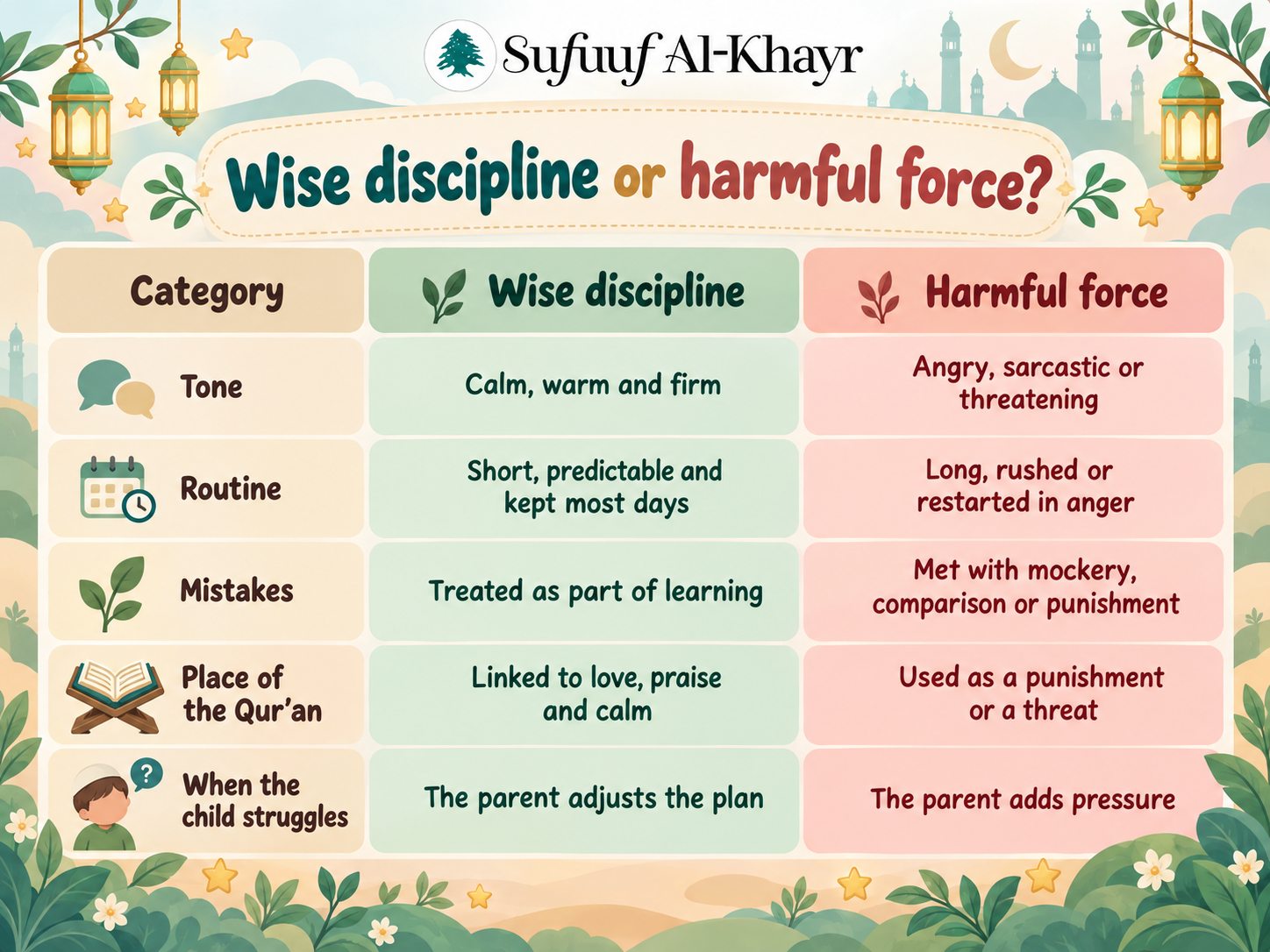
Think about what each approach says to a child. Wise discipline says, “Reading the Qur’an is an important part of our family life. We will make time for it, and I will help you succeed.” Harmful force says, “You must read perfectly, and if you struggle or resist, I will be angry with you.” Either might get a child to sit down and open the muṣḥaf, and they leave very different marks.
The distinction is between requiring reasonable effort and demanding a particular feeling. You can expect a child to take part in a short, suitable lesson. You cannot expect enthusiasm every single day, and there will be days when a child reads happily and days when they would rather be playing. Both are normal.
A child should be able to struggle with a difficult āyah without feeling that they have disappointed their parents.
What the Prophet ﷺ taught about guiding children
No single hadith settles whether a parent should make a child read Qur’an, and it would be a mistake to pretend one does. What the Prophetic example gives us is a set of principles for how any parent should teach, and they point steadily towards gentleness combined with firmness.
Gentleness
ʿĀʾishah reported that the Prophet ﷺ said gentleness adds beauty to whatever it is found in, and that its removal spoils whatever it is taken from (Muslim 2594). Anas, who served the Prophet ﷺ for ten years from his boyhood, said that the Prophet ﷺ never once said “uff” to him and never asked why he had done something or why he had not (al-Bukhārī 6038; Muslim 2309). A young servant’s years of slips and forgetfulness were met without a single sharp word.
Ease
The Prophet ﷺ told his companions to make things easy and not difficult, and to bring glad tidings rather than drive people away (al-Bukhārī 69). He also said that the religion is ease, and that anyone who overburdens himself in it will be overcome (al-Bukhārī 39). The Qur’an describes itself as made easy for remembrance (54:17), and Allah says He did not send it down to cause the Prophet ﷺ distress (20:2).
Ease does not lower the standard. It sets the load at a size the child can carry every day.
In practice, that can mean teaching fewer lines so the child can master them, revising an old lesson instead of adding a new one, or changing how something is taught while staying committed to what is taught.
Gradual steps
The Qur’an itself came down in stages. When people asked why it was not revealed all at once, the answer was that it was spaced out to strengthen the Prophet’s ﷺ heart (25:32), and that it came in portions so that it could be recited to people over time (17:106). If Allah sent the Qur’an gradually, a parent can teach it gradually. A seven-year-old does not need to carry what an adult carries.
Consistency over intensity
We saw above that the Prophet ﷺ valued steady deeds over dramatic ones. With children, that means protecting the routine at its smallest workable size, even in a hard week, rather than dropping it or cramming to catch up.
Mercy
The Prophet ﷺ once kissed his grandson al-Ḥasan while al-Aqraʿ ibn Ḥābis was sitting beside him. Al-Aqraʿ said he had ten children and had never kissed any of them. The Prophet ﷺ looked at him and said that whoever shows no mercy will be shown none (al-Bukhārī 5997; Muslim 2318). A child who feels held with mercy is more likely to keep their heart open to learning.
Taking a child’s needs seriously
The Prophet ﷺ said that he sometimes began the prayer meaning to make it long, then heard a child crying and shortened it, because he disliked causing the child’s mother hardship (al-Bukhārī 707). The prayer mattered, and he still responded to the people in front of him.
A child who is exhausted, hungry, unwell or overwhelmed may not benefit from being pushed through a demanding lesson at that moment. Sometimes the wiser choice is to shorten the session, offer support, or return when the child is more receptive. The goal stays the same, and the approach becomes more thoughtful.
Correcting without humiliating
Muʿāwiyah ibn al-Ḥakam, a new Muslim, spoke during the prayer, and the people around him reacted sharply. Afterwards he said he had never seen a better teacher than the Prophet ﷺ, before or since, because the Prophet ﷺ did not scold him, hit him or insult him. He simply explained what the prayer is for (Muslim 537). Children are learning two things at once, the Qur’an itself and what it feels like to approach it.
When a child mispronounces a letter, a patient teacher models the sound again and invites another try. When a child forgets a memorised verse, a parent can say, “That is alright, let us listen to it together and try again.” Neither response ignores the mistake, and both make correction part of learning rather than something to fear.
Teaching by example
Children watch what their parents love. A child who sees a parent reciting, even haltingly, learns that the Qur’an is something adults return to for their own sake. The Prophet ﷺ said that the best of people are those who learn the Qur’an and teach it (al-Bukhārī 5027), which includes a parent who is still learning alongside their child. We do not need to be perfect reciters for this to work, because letting children see us learn and improve is a lesson in itself.
Encouragement
The Prophet ﷺ also comforted those who find recitation hard. Whoever recites while stumbling over the words and finding it difficult has two rewards (al-Bukhārī 4937; Muslim 798). Scholars explain that one reward is for reciting and the other is for the effort. That does not place the struggling reciter above the fluent one, and it does tell us that a child working hard at a difficult letter is already earning something precious. Tell them so.
Signs you may be using too much pressure
Most parents cross the line at some point, usually on a tired evening, and noticing it is a sign of care rather than failure. These are the patterns worth watching for.
In your child
They cry, stall or complain before every session, and not only on hard days.
They say things like “I hate Qur’an class” or “I’m bad at this.”
They hide mistakes, because they have learned that mistakes bring anger.
They only read when they are threatened.
In you
You feel angry almost every time the Qur’an comes out.
The Qur’an is used as a punishment, as in “Go and read Qur’an” after misbehaviour.
Your tone, or your comparisons with siblings and cousins, has become sharper than you would accept from a teacher.
The punishment pattern deserves special attention. If the Qur’an is the consequence, a child concludes that it is a penalty, and that conclusion tends to last.
One of these signs on one bad evening is just a bad evening. A pattern over several weeks is information. A child who hides mistakes is telling you the lesson has stopped feeling safe, and a child who only reads under threat is learning compliance rather than love. Both can be fixed, and the next section shows how.
When your child refuses, look beyond the behaviour
A child who says “I don’t want to read Qur’an” is often saying something more specific. Before you answer with more pressure, it helps to ask what is making the lesson hard.
Is the work too difficult?
A child who is still learning to recognise letters can feel swamped by a full page, and a child memorising a new sūrah can lose heart if earlier passages were never properly revised. Go back to a level where they can succeed, break the lesson into smaller portions, and rebuild confidence before raising the difficulty.
Are they afraid of making mistakes?
Some children come to associate the Qur’an with being corrected, compared or criticised. They may know the material and still hesitate to read aloud, because getting it wrong feels costly. Keep corrections gentle and specific, choose one point to work on instead of interrupting every few seconds, and acknowledge the effort.
Is the timing wrong?
A lesson straight after a tiring school day can be hard even for a child who normally enjoys learning. Experiment with the time of day. A shorter session after some rest is often more productive than a longer one when the child is drained.
Do they know why they are learning?
When a lesson is made up of unfamiliar sounds, corrections and new assignments, a child can struggle to see the point. Add age-appropriate meanings, familiar Qur’anic words and stories, so they can see that the words hold guidance, mercy and lessons for their own life.
Has Qur’an time become a source of conflict?
When every lesson begins with an argument, a child may start resisting before the book is even open. Rebuild the atmosphere by starting with something familiar and enjoyable, cutting unnecessary demands and settling into a calmer routine.
Understanding the reason behind the resistance lets you respond with wisdom instead of turning up the pressure. If difficulty persists even after you have made things gentler, it is also worth considering whether a hearing, vision, reading, language or learning need is involved, and raising that with the teacher and, where appropriate, a professional.
What to do instead
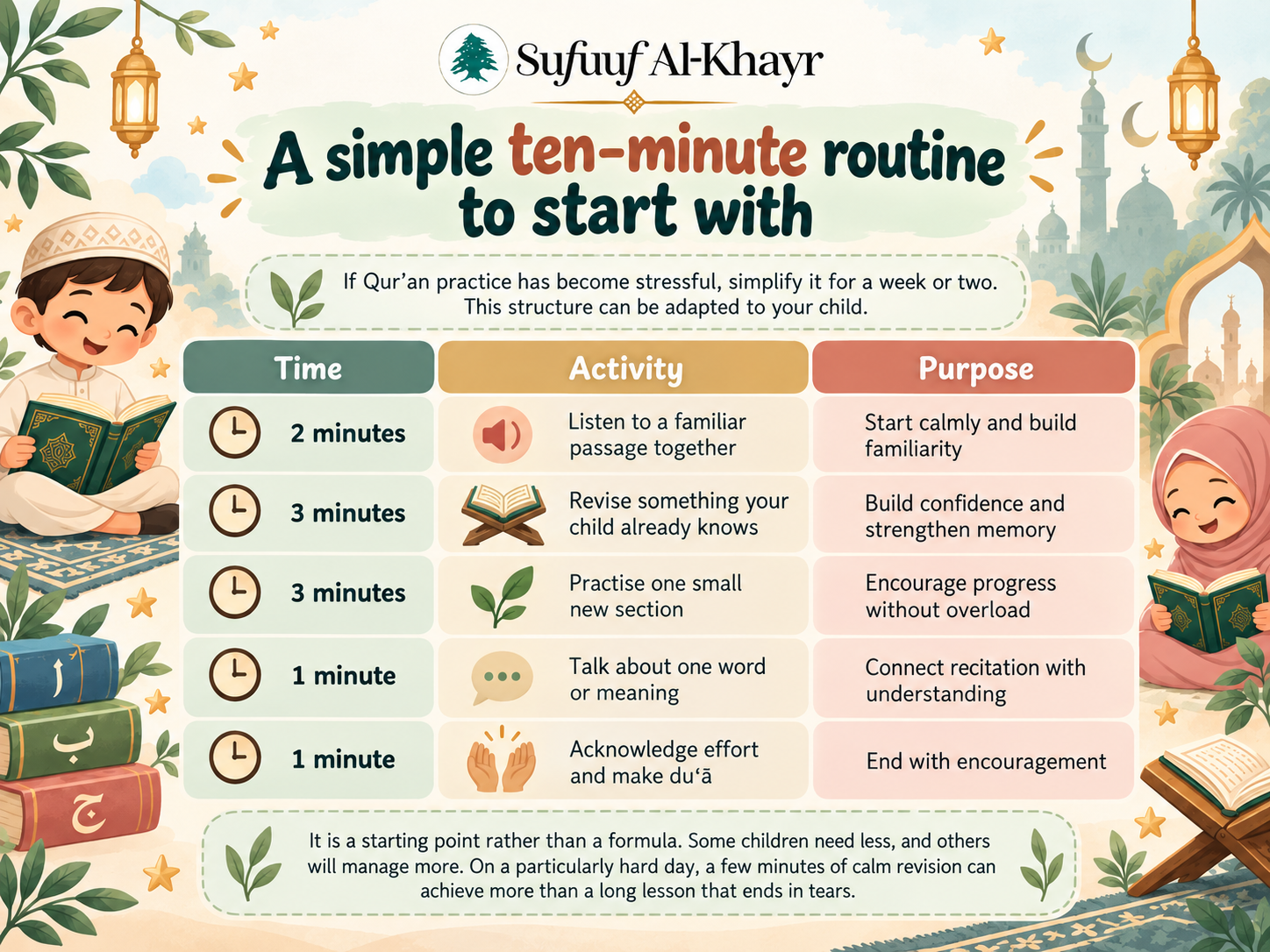
These eight steps keep the Qur’an in your child’s day and take the fight out of it. Start with the first two, add the others as they fit, and give the changes a couple of weeks before judging them.
Shorten the session. Ten focused minutes beat thirty reluctant ones. When a child is resisting, reducing the length is the first and easiest change to make.
Keep the time consistent. Tie the Qur’an to something that already happens, such as after Maghrib or before breakfast. A predictable slot removes the daily negotiation, because the question stops being whether and becomes when. Within that slot, offer small choices, such as which sūrah to start with or whether to read now or after a snack, so the routine stays fixed while your child still has a say.
Start with something they can do well. Open with a sūrah they know. Beginning with success sets the mood for everything after it.
Praise one improvement. Make it specific, true and small, such as “The ending of that āyah was much clearer than yesterday.” Another might be “You remembered the beginning without my help.” Children trust praise that is precise.
Use beautiful recitation. Play a reciter your child enjoys while you cook or drive. Beauty draws children in far more reliably than pressure does. Now and then, add one small meaning, such as what Sūrat al-Fātiḥah is asking Allah for, so the sound and the sense grow together.
Ask what feels difficult. Ask with curiosity rather than suspicion. The answer may be a particular letter, the length of the lesson, the time of day, or a worry about disappointing you. Simple questions work best, such as “What is the hardest part of Qur’an class for you?” or “What would make it easier to learn?” Then listen before offering solutions.
Let the teacher guide the pace. Pace is a judgement call, and a teacher who knows your child will usually make it better than a parent under pressure. If the teacher says to slow down, trust that.
Make duʿā with your child, not only for your child. Sit beside them and ask Allah together to make the Qur’an easy and beloved to them. You might use the duʿā of Mūsā ʿalayhi al-salām, asking Allah to open his chest and ease his task (20:25-26). Children learn that this is a shared effort, and that even a parent asks for help.
None of this lowers the expectation. The Qur’an still has its place in the day, and the child still shows up. What changes is the atmosphere around it.
The role of the teacher
A good teacher is the most useful diagnostic tool a parent has. Parents see a child who is resisting, and a teacher can often see why. These are the questions worth asking together.
Is my child struggling with confidence?
Is the level too hard for them right now?
Is the routine too inconsistent for the habit to settle?
Am I expecting too much, too soon?
Does my child need review rather than new material?
The answer is often smaller than parents fear. A child who seems unwilling is sometimes a child working one step above their level, and a few weeks of review can rebuild confidence before new material returns. A teacher can make that call. A frustrated parent at the end of a long day usually cannot.
The teacher’s manner matters just as much. Look for someone who corrects the way the Prophet ﷺ did, firmly and clearly and without humiliation, and who knows your child well enough to see when a lesson is landing and when it is not.
At Sufuuf al-Khayr, each child has one private 30-minute session a week with a teacher who knows them by name, along with a short recorded lesson that previews new material. At home, parents guide 10 to 15 minutes of practice using clear notes on what to listen for, and receive concise weekly updates and an end-of-term report. That division of roles leaves the teacher to teach and the parent free to encourage.
This matters especially in online learning, where individual attention and clear communication with parents make a real difference. Our Qur’an Recitation and Tajweed program is built on personalised lessons, patient teacher modelling, gentle correction and structured practice, so that children develop clearer recitation and greater confidence at a pace that suits them.
Firm about the Qur’an, gentle in the path
Parents who ask whether to force a child to read Qur’an are really asking how to protect two things at once, the Qur’an’s place in the child’s life and the child’s love for it. The Prophetic example says to hold both. Keep the routine, and soften the way you keep it.
A child who resists is not necessarily a child who rejects the Qur’an. Often they are asking for a smaller step, a calmer voice, or someone to notice how hard they are trying.
It is worth asking what kind of relationship you hope your child will have with the Qur’an at twenty. By then they may be living independently, studying or working, and you will not be there to remind them to revise a sūrah or open the muṣḥaf. What remains will be the knowledge they gained, the habits they built and the relationship they formed over many years.
We cannot guarantee that every child who enjoys Qur’an lessons will become a devoted adult reciter, and a child who resists today may not always struggle. Guidance belongs to Allah, and every journey is different. What we can do is give children a strong beginning, one where they learn that the Qur’an deserves commitment and that mistakes are part of getting better.
If your child is resisting and you are not sure why, a free assessment can help. At Sufuuf al-Khayr we listen to your goals, look at where your child actually is, and propose a Qur’an routine that fits your child and your week.
May Allah make the Qur’an beloved to our children, and make us gentle and wise guides for them. Āmīn.
Frequently asked questions
-
Be firm about the routine and gentle in how you hold it. Do not drop the Qur’an because your child resists, and do not use anger, threats, shame or physical harm to make them comply. The aim is a child who keeps coming back to the Qur’an because it feels safe and beloved.
-
No single hadith says this in so many words. What we have are authentic Prophetic teachings on gentleness, ease, mercy and steady progress, which are set out above and which shape how a parent should teach. For a specific question about your family, please ask a qualified scholar.
-
That narration is about ṣalāh, and it does not mention Qur’an lessons. What it shows is that a parent’s expectations are gradual and tied to age, with instruction coming first. Scholars who discuss the part about physical discipline at ten attach firm limits to it, and nothing in the narration permits harshness, humiliation or harm. Please take any question about discipline to a qualified scholar. For Qur’an learning, the steps in this post are where we would start.