
Why Should Children Learn Arabic and Qur’an Together?
“Should my child focus on Qur’an first and learn Arabic later?”
It is one of the most common questions we hear from parents, and it is a sincere one. Most parents who ask it want to protect their child’s time, energy and love for the Qur’an, and that instinct deserves respect.
Our answer is that Arabic and Qur’an do not need to take turns. When children learn them side by side, the language of recitation slowly becomes the language of recognition, meaning and connection.
The short answer. Yes, children can learn Arabic and Qur’an together, as long as the Arabic is light, age-appropriate and tied to the words they are already reciting. This post explains why we teach them together at Sufuuf al-Khayr, what it looks like for a young child, and how to keep the experience warm rather than heavy.
Arabic is the language of the Qur’an
Allah revealed the Qur’an in Arabic, and the Prophet ﷺ conveyed it to his people in that same language. The Qur’an says so itself. In Surah Yusuf, Allah describes it as an Arabic Qur’an, sent down so that people may use their reason and understand (12:2).
For Muslims, Arabic holds a sacred and civilisational place. It is the language of the adhān, of the daily prayers and of worship everywhere. A child in Lahore and a child in Toronto stand in ṣalāh and recite the same words. It is also the language in which generations of scholars wrote tafsīr, ḥadīth, fiqh, history and poetry, so Arabic opens a door to far more than a single book.
This is why we hesitate to call Arabic a “foreign language” for Muslim children, even when nobody at home speaks it. A child who learns Arabic is gaining access to the language of their dīn. That changes how a lesson feels, because the child is stepping into something that was always meant for them.
This matters most for children who grow up surrounded by English, at school, online and with friends, and sometimes at home too. Their Islamic vocabulary can shrink to a handful of phrases they hear now and then, and if Arabic stays entirely unfamiliar, parts of worship can start to feel distant from the rest of their world.
Early, gentle Arabic changes that. Allāhu Akbar stops being only a phrase the adults say and becomes words with a meaning the child can hold. Rabb becomes the Lord who created and cares for them, and hudā becomes the guidance they ask Allah for.
Arabic gives children keys to meaning
A child does not need grammar to begin understanding the Qur’an. A small handful of words is enough to change what recitation feels like, and most of these words are ones children have already been saying for years. Here are a few they meet very early.
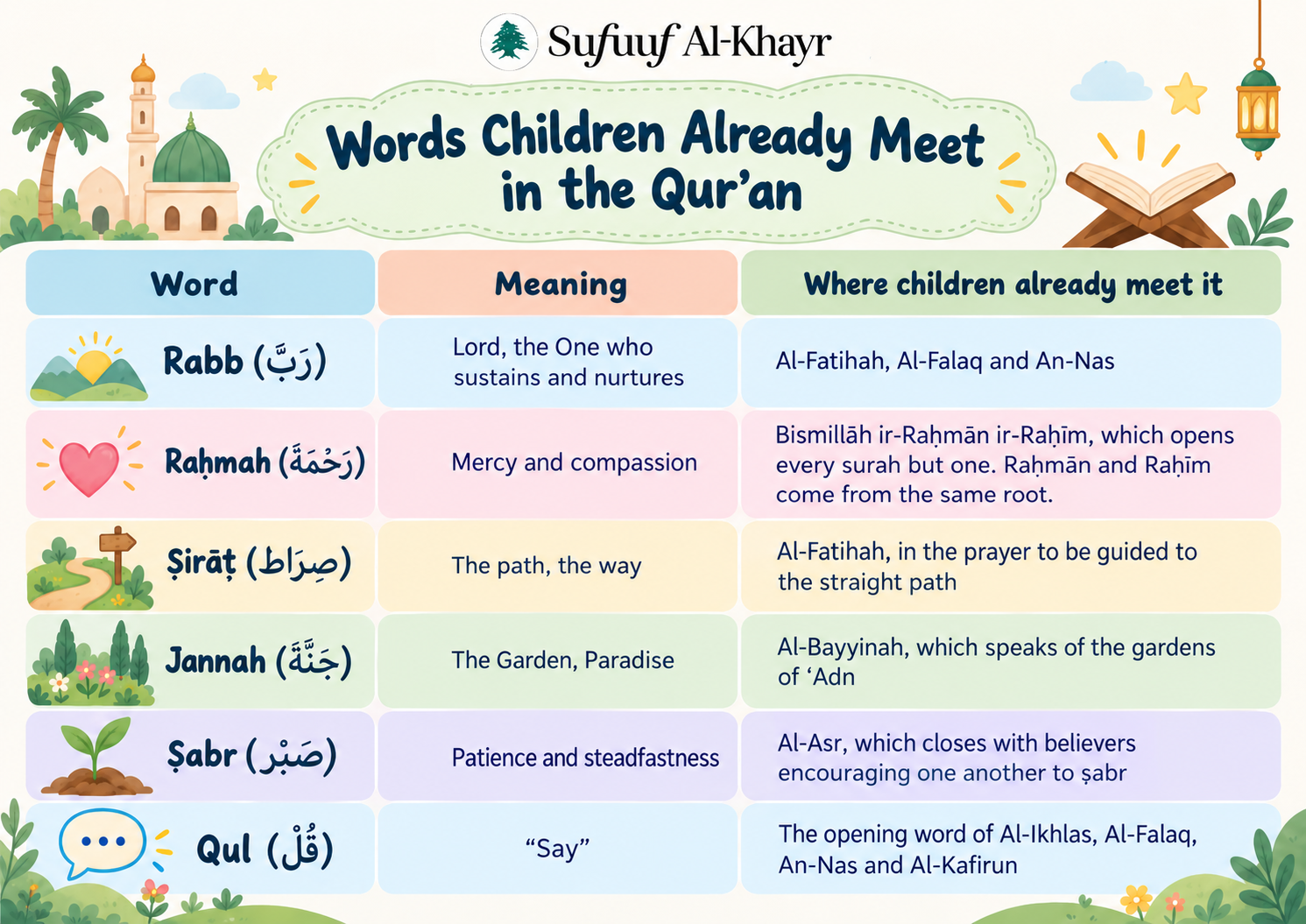
Children also pick up words like hudā (guidance), nār (the Fire), qalb (the heart), nūr (light) and kitāb (book) quickly, because these short words turn up all the time.
Then there are the phrases that return again and again. Yā ayyuhā alladhīna āmanū, “O you who believe,” appears whenever Allah addresses the believers directly. Once a child learns to spot it, a long page stops looking like a wall of unfamiliar sounds and starts looking like something with patterns they know.
Imagine a seven-year-old reciting Al-Asr. For months it was a rhythm she had memorised. Then one day she learns that the last word means patience, and the surah starts saying something to her. Weeks later you ask her to wait for dinner and quietly say ṣabr, and she knows exactly which word you are using and where she has heard it before.
Every word a child recognises becomes a small light inside their recitation.
The child may not follow the whole āyah or the grammar behind it, and that is fine. They are simply no longer hearing only unfamiliar sounds.
Allah invites us to reflect on the Qur’an (47:24). For a child, reflection begins with something very small, and recognising a single word is a real first step.
Arabic gives children the keys, and the Qur’an is the most beautiful place they will ever get to use them.
Qur’an gives Arabic spiritual depth
Arabic can turn dry very quickly when it is cut off from faith. Vocabulary lists, drills and worksheets feel like any other school subject, and children notice. The Qur’an gives the language a reason to live in a child’s heart.
Letters stop being random symbols. The bāʾ a child traces in a notebook is the first letter of Bismillāh, the word they say before they eat and before they begin almost anything. Sounds that are hard to produce, like the heavy ṣād or the deep ʿayn, turn out to be the sounds of ṣalāh and ʿālamīn, so practising them feels a lot like practising worship.
Words begin to connect to Allah, to the Prophet ﷺ and to Islamic history. Names like Ibrāhīm, Mūsā and Maryam are Arabic words a child learns to read, and each one carries a story they already love. The vocabulary arrives with the stories of the prophets attached.
Take raḥmah. A child who learns it as a vocabulary item has learned something useful. A child who meets it in the Qur’an, connects it to Allah’s mercy, and then hears a teacher ask, “How can we show mercy to your little brother today?” has learned something that follows them out of the lesson.
Over time something quiet happens. The child begins to feel that Arabic belongs to them. It stops being the language of somebody else’s textbook or a distant country, and they start reading it on a mosque wall, on a duʿāʾ card or in the muṣḥaf with a little pride. For children growing up where Arabic is not spoken at home, that feeling matters a great deal.
Why learning them together helps children remember
Children remember what they meet more than once, in more than one place, and in a setting that matters to them. Learning Arabic and Qur’an together gives them all three.
Repetition across two settings
A word taught in an Arabic lesson on Monday shows up again in the surah a child recites on Thursday. That second meeting, in a different setting, usually helps the word stick far better than drilling the same list a second time.
The same word can turn up in reading, listening, recitation, discussion and practice at home. Each meeting strengthens memory, and each one also gives the word a place in the child’s religious life.
Vocabulary in its real context
A language feels abstract when you cannot see what it is for. Here the purpose is in front of the child every time they pray or recite.
The Qur’an feels closer
Recitation without any understanding can feel distant, even when the child is doing everything correctly. A little meaning brings it nearer, and a child who feels close to the Qur’an is more likely to keep coming back to it as they grow.
From recitation to relationship
Recitation is a noble and essential part of a child’s Qur’an journey. Children should learn to read clearly, pronounce correctly, take on tajwīd gradually and grow in confidence with the muṣḥaf. Nothing in this post asks you to put that second.
Most parents also want something more. They want their child to have a relationship with the Qur’an, and Arabic helps build that bridge. When a child starts to recognise words and meanings, the Qur’an stops feeling like something outside them. They begin to ask questions, to notice patterns, and to feel proud when a word they know turns up somewhere new.
This matters a great deal for children growing up in English-speaking environments, where school, screens, friends and wider culture all compete for attention. Arabic and Qur’an together give a child roots. They show a child that Islam is a living tradition with its own language, history and beauty, and that it belongs to them.
How to avoid overwhelming your child
The honest worry behind this whole question is that two subjects will be too much. That worry is fair, and the answer is to keep the Arabic small.
At the beginning, the goal is not heavy grammar. Arabic should be age-appropriate and should start with what young children respond to most easily, which is sounds, letters, simple words, short phrases, stories and meanings connected to daily life. Listening and speaking come before heavy reading and writing. If the experience stays positive, children are happy to go further when they are ready.
Some of these stages will overlap. A beginner can still enjoy Qur’anic stories, and a fluent reader will continue refining pronunciation. The point is not to force every child into a rigid sequence, but to meet them at their present level and help them take the next meaningful step.
Depth matters more than speed
Parents sometimes feel pressure to choose the fastest path. How quickly can my child finish the Arabic book? How quickly can they complete a juz? Those goals have their place, but speed and depth are different things. One child rushes through pages without confidence, while another moves more slowly and ends up with stronger pronunciation, better retention, a happier relationship with learning and a clearer sense of what the words mean.
Teaching Arabic and Qur’an together is not meant to slow a child down. It is meant to give the journey roots, and a foundation like that takes patience and stays with a child for life.

Signs the balance is right
They ask what a word means, or point out one they recognise.
They want to tell you something they learned.
They are happy to start a lesson, even on a tired day.
Signs it is too much
Dread or tears before lessons.
Saying they hate Arabic, or the Qur’an, or both.
Losing confidence in recitation they used to know well.
If you notice these, slow the Arabic down and talk to your child’s teacher. The aim is a child who still loves both when they are fifteen.
Simple ways to support Arabic and Qur’an at home
You do not need to speak Arabic to help. A parent’s curiosity does a surprising amount on its own.
Pick one word a week from what your child is reciting and use it in everyday conversation. If the word is raḥmah, you might ask, “How can we show raḥmah to your little sister today?” Write it on a card for the fridge if that helps.
After ṣalāh, ask what a word they just said means. If neither of you knows, find out together, because “let’s find out” teaches more than a quick answer.
After Qur’an class, ask which word they learned today, or whether they spotted any word from the Qur’an. Questions like these show a child that you care about meaning as well as performance.
Play a short recitation of the surah they are learning while you cook or drive, and pause whenever you hear a word you both know.
Keep practice short and calm. A peaceful ten minutes usually does more good than a long, stressful session.
Celebrate recognition. When your child spots a word in a surah, make a small occasion of it, because that moment is the Qur’an becoming more accessible to them.
Let your child teach you. Children hold on to words they have had to explain.
How Sufuuf al-Khayr teaches Arabic and Qur’an together
At Sufuuf al-Khayr, we believe children benefit when Qur’an and Arabic are taught in a way that is structured, gentle and meaningful. Children need clarity and they need warmth, and they need to feel that the words they are reading matter.
Our approach brings several strands together, each supporting the others.
Qur’an recitation and fluency. Reading from the muṣḥaf with growing confidence, with tajwīd introduced gradually according to age and level.
Arabic vocabulary and comprehension. Useful words from Islamic life and Qur’anic recitation, reviewed often until they feel familiar, with simple Arabic understood directly rather than always through translation.
Stories and meanings. Verses, sūrahs and vocabulary connected to stories from the Qur’an and Islamic tradition, so lessons feel alive and memorable.
Adab, tarbiyah and Islamic identity. Learning tied to manners, worship and character, so knowledge reaches the heart and daily actions as well as the mind.
Personalised guidance. The balance shifts according to each child’s level.
Support for parents. Guidance on what to review and how to encourage your child at home without turning it into pressure.
Some children need more focus on reading. Others are ready for vocabulary and comprehension, some need to rebuild confidence, and some need a stronger challenge. The right balance depends on the child.
Bringing it together
When Arabic and Qur’an are learned together, a child’s bond with the Qur’an grows from several directions at once. The sounds become familiar, the words begin to mean something, and the whole thing starts to feel like theirs. Over time it begins to shape how they pray.
Every child’s journey is different. Some need to strengthen their letters and fluency, some need help with tajwīd, some are ready to begin recognising meanings, and some need a warmer, more encouraging experience to rebuild their confidence. At Sufuuf al-Khayr, we help parents see where their child is and what the next step should be.
Book a free consultation to explore the right balance of Qur’an recitation, tajwīd, Arabic vocabulary, understanding and parent support for your child.
May Allah make the Qur’an the spring of our children’s hearts. Āmīn.
Frequently Asked Questions
-
For most children there is no need to wait. Children can start with Qur’an and add light Arabic early, as long as the Arabic stays small and linked to the words they are already reciting. Waiting can mean years of reciting without understanding, which makes the Qur’an feel more distant than it needs to.
-
There is no single right age. Young children can begin with sounds, stories and simple words, and the pace should follow the child. The age guide above is a starting point rather than a rule.
-
Not at the beginning. Vocabulary, repeated phrases and the meanings of the surahs they recite give a child plenty to work with. Grammar can come gradually when they are older and ready for it.
-
Yes. Many Muslim families are in the same position. What helps most is a parent who shows interest, asks about new words and celebrates progress, even without knowing the answers.
-
That is very common, and it is a good place to start from. Your child can keep improving recitation while gradually adding Qur’anic vocabulary and simple Arabic comprehension. Even small steps in Arabic can make recitation feel more meaningful.
-
It does not need to. When Arabic is light and connected to what the child is reciting, the words carry meaning, and meaning helps memory. If your child seems overloaded, slow the Arabic down and adjust the balance rather than dropping either one.
-
No. Correct recitation with tajwīd stays central, and understanding is added on top of it. Recitation is the foundation, and meaning is what brings it to life.