
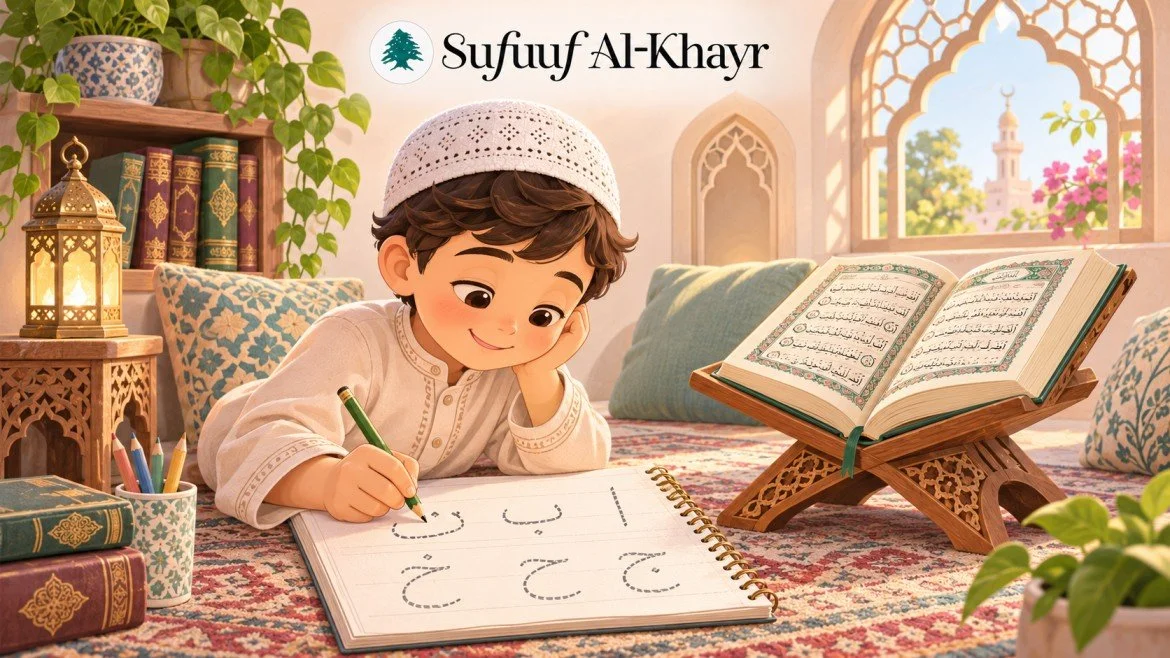
Your child may learn French at school, Spanish from a friend, or Mandarin because it might be useful one day. Arabic belongs to a different category, and it deserves to be spoken about differently.
For a Muslim child, Arabic is the language Allah chose for His final Book. It is the language of the adhan, of the words they will say in salah for the rest of their life, and of the verses their parents and grandparents recited before them. No other language sits so close to their deen.
Picture a child who has recited Surat al-Fatihah hundreds of times. They know its sounds by heart and say it in every salah, just as their parents taught them. Then one day someone explains ihdina al-sirat al-mustaqim, “guide us to the straight path.” The child realises that each time they stand before Allah, they are asking Him for guidance. The words have not changed, and the child’s relationship with them has begun to deepen.
Many parents who do not speak Arabic themselves feel this keenly, and wonder how to give their children more access than they had. This post is a reflection on why Arabic holds such a place, what it means for a child to grow up close to it, and how parents can nurture that closeness gently. It is more devotional than most of what we write, and we have tried to be honest about what is firmly established and what is simply beautiful.
The short answer. Teaching Arabic to a Muslim child is more than academic enrichment. It opens the door to a spiritual inheritance, and the surest way to walk through it is with the Qur’an, with meaning, and with love.
Arabic as the language of revelation
The Qur’an was revealed in Arabic, and Allah says so more than once. He describes it as an Arabic Qur’an sent down so that people may understand (12:2; 43:3), and as revelation in a clear Arabic tongue (26:195). The Prophet ﷺ received it, recited it and taught it in that same language.
إِنَّا أَنزَلْنَاهُ قُرْآنًا عَرَبِيًّا لَّعَلَّكُمْ تَعْقِلُونَ
Surat Yusuf, 12:2
What followed was a long, careful effort by Muslims to carry the Qur’an exactly as it was received, with its sounds, its letters and its meanings intact. Allah promises to preserve it (15:9), and He did so through people. Teachers passed recitation to students, each learning directly from the one before, and many reciters today hold an ijazah that traces their recitation through a chain of teachers back to the Prophet ﷺ. Scholars sometimes call this living chain of learning a silsilah.
A child who learns Arabic steps into that stream. When they pronounce a letter correctly, they are using a sound that Muslims have guarded with care for some fourteen centuries.
This inheritance is living and not a museum piece. It is recited every day, in every time zone, by people of every background, and a child who learns Arabic joins that recitation.
Translations are immensely valuable, especially for families who do not speak Arabic. Even so, a translation explains the meaning in another language and cannot always carry every shade of expression, emphasis and beauty of the original. Learning Arabic gradually lets a child meet more of those meanings directly, so that the language of revelation becomes familiar instead of something approached only through translation. That familiarity can begin much earlier than many parents imagine.
The beauty and mystery of the Arabic letters
Muslim teachers and writers have long spoken about the beauty of the Arabic letters, and some have spoken of a sirr in them, a hidden depth that is felt more than explained. That tradition of reflection is worth honouring. It is also worth handling with care, so we will stay close to what the Qur’an and the Sunnah themselves tell us.
Start with where revelation began. The first word to reach the Prophet ﷺ was “Read,” and the first verses speak of the One who taught by the pen (96:1-5). Allah later swears by the pen and by what people write (68:1), and in Surat al-Rahman He speaks of teaching the Qur’an and then teaching human beings clear expression (55:1-4). Writing and speech sit near the heart of the message.
Then there are the letters themselves. The Prophet ﷺ said that whoever recites a letter from the Book of Allah earns a good deed, and each good deed is multiplied tenfold. To make it concrete, he added that Alif-Lam-Mim is not one letter, but Alif is a letter, Lam is a letter and Mim is a letter (al-Tirmidhi 2910). A single letter, recited as part of the words of Allah, carries reward. That is the Prophet’s own way of showing us that these are not ordinary marks on a page.
This is worth telling a child, because the alphabet is hard work at first. Some letters differ by only a dot, others change shape depending on where they sit in a word, and sounds like ayn (ع) and ha (ح) need careful listening. A child who struggles with one should not feel embarrassed, because they are learning something worth approaching patiently. A simple reading lesson can become the beginning of a lifelong relationship with the Book of Allah.
Twenty-nine surahs begin with letters pronounced by their names, such as Alif-Lam-Mim and Ha-Mim. Scholars have offered several explanations. Some say the letters are names for their surahs. Others see a quiet reminder that the Qur’an is built from the very letters the Arabs used, yet cannot be matched. Many hold that their meaning is known to Allah alone. We recite them with reverence, and we do not need to claim to know more than that.
For a child, none of this needs a lecture. It lands in small moments. The alif they trace in their first lesson is the first letter of the opening of Surat al-Baqarah, and the ba they practise begins Bismillah. When a teacher lets a child feel that connection, the letters stop being shapes on a worksheet.
We do not claim that the shapes of the letters hold hidden powers, and we would not want a child taught to think so. Their dignity comes from what they carry, which is the words of Allah, and from the reverence with which they are learned.
Arabic connects the child to worship
Almost everything a Muslim child does in worship is done in Arabic, and most of it from memory. A child can say the words of salah perfectly for years without knowing what they mean. A child who recites without yet understanding is doing nothing wrong, and understanding simply adds presence and love.
Many Muslim children know more Arabic than they realise. They say Bismillah before eating, Alhamdulillah when asked how they are, and they hear Allahu Akbar all day long. A child who has said Alhamdulillah for years may have a small moment of discovery when they learn that they are praising and thanking Allah.
The Prophet ﷺ reported that Allah says He has divided the prayer between Himself and His servant, and that when the servant says, “All praise belongs to Allah, Lord of the worlds,” Allah replies, “My servant has praised Me” (Muslim 395). A child who understands Al-Fatihah is no longer only reciting. They are speaking to their Lord and being answered.
Arabic connects the child to the ummah
A Muslim child in Jakarta, one in Lagos and one in Birmingham may share no spoken language at all. In salah, they recite the same words. Allah calls the believers one ummah (21:92), and Arabic is one of the threads that makes that visible. Muslims who cannot otherwise talk to each other can greet one another with salam, say Bismillah before eating, and stand side by side in a masjid on the other side of the world knowing exactly when to bow.
It also connects a child backwards in time. The Qur’an they recite is the Qur’an recited by the Companions, and the dua they say is the dua their grandparents said. Some of those Companions were not Arab by birth. Bilal came from Abyssinia, Salman from Persia and Suhayb from Byzantine lands, and each made the language of revelation their own.
That is worth telling children, because Arabic belongs to no single ethnicity. In his farewell sermon the Prophet ﷺ said that no Arab has superiority over a non-Arab, nor a non-Arab over an Arab, except through taqwa (Ahmad 23489). A child of any background has as much right to the language of the Qur’an as any other.
Some children will say, “But we aren’t Arab, so why do I need to learn Arabic?” That is a good moment for a conversation. Arabic is not the exclusive inheritance of Arab Muslims, because it is the language of the Qur’an and the Qur’an belongs to the whole ummah.
Learning it does not ask a child to give up their mother tongue either. Allah counts the diversity of human languages among His signs (30:22), and a child can love Urdu, Tamil, Somali, Turkish, Malay or English while building a special relationship with the language of revelation. The two do not compete.
For children growing up as a minority, this matters in a very practical way. Their faith may be one of the few things that sets them apart at school, and it can feel like something they carry alone. Arabic tells them they belong to something much larger than their street or their classroom, and much older.
Arabic gives dignity to Islamic identity
Children notice early what their world treats as normal. If Islam appears in their week only as a handful of phrases they half understand, it can start to feel like something attached to their life from outside. For English-speaking children especially, Arabic helps change that in four ways.
Islam is not foreign to them
When a child can read the words on a masjid wall, understand Allahu Akbar, and follow what the imam is reciting, Islam stops being a set of unfamiliar customs. It becomes a language they are learning to speak.
The Qur’an belongs to them
A child who recognises words in the Qur’an, even a few, stops treating it as a book that belongs to adults or to Arabic speakers. It is theirs, and they can say so with some confidence.
They have access to their tradition
Arabic is the key to the Qur’an, the Sunnah, the duas and the sermons that carry the tradition. A child who starts early keeps that door open for life, and does not have to depend on someone else’s translation to meet the sources.
They are part of something ancient and noble
Dignity grows from knowing where you come from. A child who learns Arabic learns that their faith has a language, a history and a literature stretching back fourteen centuries, and that they are now one of the people who carry it. Islamic knowledge did not begin with their textbook, their online class or their local masjid, and a child who learns Arabic starts to feel the length of the chain they are joining.
A child who feels all this can carry their faith with quiet confidence, without apologising for it or shrinking it into something easier to explain.
Arabic is a living language, too
Sometimes Arabic reaches children almost entirely through memorisation, written exercises and grammar rules. Those have their place, but if Arabic is only ever drills and corrections, children can struggle to love it. It helps for them to discover that Arabic is also a language for asking a question, describing their family, following a short story and saying how they feel.
That does not replace the study of Qur’anic Arabic. Age-appropriate reading, listening and conversation build the confidence and familiarity that Qur’anic vocabulary and classical texts later rest on, and children who enjoy using Arabic may be more willing to keep going. The aim is not to rush every child towards advanced scholarship. It is to build a foundation solid enough, and positive enough, to carry them further if they choose.
Simple ways to help your child feel Arabic’s place at home
You do not need to speak Arabic yourself. These small habits let a child feel what this post has described.
Pick one phrase from salah each week, tell your child what it means, and listen for it together the next time you pray. You could start with Alhamdu lillah and ask, “What are three blessings from Allah we can be thankful for today?” Later, try Iyyaka nastain and ask, “When might we ask Allah for help?”
Tell your child that every letter of the Qur’an they recite carries reward (al-Tirmidhi 2910). Children enjoy knowing that every letter they recite is counted, even a difficult one.
Say salam and Bismillah slowly and on purpose, with the meaning in mind, and teach your child to answer a greeting fully.
Learn one name of Allah a week, such as Ar-Rahman or Al-Latif, and use it when you make dua together. You can also explain the meaning of a dua your child already knows by heart, and when it is said.
Let your child see Arabic as beautiful. Look at calligraphy together, or let them practise writing Bismillah in their best handwriting.
Share the stories of Bilal, Salman and Suhayb, so your child sees that people from every background made Arabic their own.
Read or listen to simple Arabic stories at your child’s level. Beginners may enjoy pictures and a few repeated words, and it should feel like a treat and never another homework task.
Celebrate curiosity over perfection. When your child spots a word in the Qur’an, make a small occasion of it, and if they ask something you cannot answer, “Let’s find out” is a perfectly good reply.
Start with one of these and keep it light. A child who senses your warmth towards Arabic will usually come to feel it too.
A spiritual inheritance worth passing on
Teaching Arabic to a child is more than academic enrichment. It hands them access to their spiritual inheritance, which is the language of the Book they will recite, the prayers they will make and the ummah they belong to.
None of this needs to be heavy. A child can meet Arabic through stories, through a few meaningful words a week, and through the Qur’an they are already learning. If you are wondering how to teach Arabic and Qur’an together without overwhelming a child, we explore that in Why Should Children Learn Arabic and Qur’an Together?
Not every child will become a scholar of Arabic, and not every child will study the classical texts in depth. Every child deserves the chance to approach the language of revelation with confidence, understanding and love. And perhaps one day, as they stand in salah and recite a familiar verse, they will notice a meaning they never saw before. The words will be the same, and their heart will understand a little more.
At Sufuuf al-Khayr, we help English-speaking children approach Arabic through Qur’an, meaning and love. Our Arabic for Kids program is a structured, age-appropriate pathway into Classical Arabic, built on the Jannaty curriculum. It is story-based and builds reading, writing and comprehension without constant translation. Children learn to read with their eyes, grow their vocabulary in context, and begin to think in Arabic naturally.
Short recorded lessons preview new material, and personalised live sessions give each child individual guidance and encouragement. Islamic values and good character stay part of the learning, so that Arabic becomes something a child grows to understand, enjoy and value.
Book a free assessment at RowsOfGoodness.com, and we will listen to your goals, place your child appropriately, and suggest a routine that fits your week.
May Allah make His Book and the language of His Book dear to our children, and make them among the people of the Qur’an. Ameen.
Frequently asked questions
-
Arabic is the language Allah chose for the Qur’an, and it is the language of salah, dua and the adhan. A child who learns it gains closer access to their worship, their tradition and the wider ummah, and a stronger sense that their faith belongs to them.
-
No. Arabic has a special religious significance for Muslims of every background, because it is the language of the Qur’an. Learning it does not require a child to become culturally Arab or to leave their own heritage language behind.
-
There is no single age that suits every child. Young children can begin with listening, sounds, stories and simple words, while formal reading and writing should follow each child’s development and readiness.
-
You will often hear this, and it is worth being careful. The narration usually cited for it, “Love the Arabs for three reasons,” has been graded very weak by hadith scholars, and some, including al-Dhahabi and Ibn al-Jawzi, called it fabricated. Other scholars have said that without clear, sound evidence the safest position is to hold back and leave the matter with Allah. For that reason we do not present it as established. What is firmly established is that the Qur’an was revealed in Arabic and that Arabic is the language of our worship.
-
Muslim teachers have long reflected on the beauty and hidden wisdom of the letters, and that reflection deserves respect. What is firmly established is that reciting a letter from the Book of Allah earns reward (al-Tirmidhi 2910). Scholars differ on the opening letters of the surahs, and many hold that their meaning is known to Allah alone. We avoid claiming more than that.
-
No. Faith does not depend on fluency, and many sincere Muslims throughout history have not spoken Arabic. What Arabic offers is closeness, because it lets a child understand more of their salah, the Qur’an and their dua. For specific questions about what is required in worship, please ask a qualified scholar.
-
Not when it is taught gently. Children can begin with sounds, stories and familiar Qur’anic words, and grow from there at their own pace. We explain how in Why Should Children Learn Arabic and Qur’an Together?
-
Yes. Parents can encourage regular practice, listen to their child read, explore simple Qur’anic vocabulary together, and show real interest in what their child is learning. A supportive home matters even when the parent is learning alongside the child.